Anonymization scope
This page is the deep dive behind the README's What it anonymizes table. It describes, category by category, what the detector flags on a penetration-test report, what placeholders it produces, and the classes of strings the pipeline deliberately leaves alone so the report's technical content keeps working.
The source of truth for these rules is prompts/system_detector.txt
in the default Fast detection mode; the deterministic regex layer that runs
before the LLM lives in
config/leak_patterns.yml.
When the High accuracy (multi-pass) mode is selected from the
Pipeline tab toggle, the same rules live category-by-category under
prompts/detector_multipass/
(one focused prompt per category, ~800 tokens each).
The placeholder substitutions and category-specific format rules
are in prompts/system_critic.txt
and anonymize/placeholders.py.
Design principles
- The technical content stays. Attack chains, exploit code, shell commands, payloads, tool output, library names, RFC ranges, generic versions: these are what makes the report useful as a teaching artefact and must remain untouched. A pentest report should remain readable by another pentester after anonymization.
- Only customer-identifying values move. The detector's precision checklist is "if I removed this value, would the attack logic still be understandable?", if yes, it is a leak; if no, it is technical description.
- Placeholders are length- and shape-preserving. PDFs are redacted in place, so a 17-character phone number must be replaced by a 17-character placeholder; a 32-hex token by a 32-hex placeholder; a brand name by a brand-shaped neutral string. This avoids reflow.
- Same value → same placeholder, every time. A real value
that appears twice (in different cases, in different formats,
inside a URL or a payload) gets the same neutral substitute
on every occurrence. The mapping persists in
substitution_map.yml. - Multilingual. Reports come in any language; the detector analyses the input in its native language and emits language-neutral placeholders.
The 12 categories
1. brand: customer / product names
The customer's company name, product line, suite, vendor, app name, and any of their case variants when they appear inside URLs, package names, header names, advisory IDs, etc.
| Original | Placeholder |
|---|---|
AcmeBank Pro v25.1.2135 |
VendorApp v25.1.2135 |
acmebank (lowercase, in a URL) |
vendorapp |
ContosoVoice |
VendorVoice |
NimbusGSM |
VendorGSM |
The detector flags every form of the brand. If the same word
appears as a domain (acmebank.com), as a package (com.acmebank),
as a header (X-AcmeBank-Auth) and as a deeplink (acmebank://),
each occurrence gets its own candidate so the placeholder rewrites
the full token.
2. network: IPs and hostnames
Real public IPv4 addresses of the customer, the customer's owned domains, and proprietary hostnames under those domains.
| Original | Placeholder |
|---|---|
203.0.113.42 (real public IP) |
203.0.113.NN |
api.acme.com |
api.vendor.example |
*.prod.acme.io |
*.prod.vendor.example |
keyserver.acmebank.local |
keyserver.vendor.local |
Placeholders use the RFC 5737
documentation ranges (203.0.113.0/24, 198.51.100.0/24,
192.0.2.0/24) and the RFC 2606
.example TLD so the placeholder is itself valid demo data and
will not collide with anyone's real assets.
Not flagged: RFC 5737 ranges, RFC 1918 (10.x, 172.16-31.x,
192.168.x), loopback (127.0.0.1), well-known public DNS
(8.8.8.8, 1.1.1.1), generic descriptive endpoints
(/api/v1/login, /healthz, keyserver/v1/publish).
3. phones: E.164 numbers
Any-country phone numbers in any format. The placeholder keeps the country code and the carrier prefix, then zeroes out the rest with a sequential index of equal length.
| Original | Placeholder |
|---|---|
+39 344 1234567 |
+39 344 0000001 |
+1 (415) 867-5309 |
+1 (415) 555-0001 |
+44 7700 900123 |
+44 7700 000001 |
Not flagged: RFC reserved test ranges (+393440000001,
+1-555-0100), already-anonymized numbers.
4. emails: customer-domain emails
Addresses on the customer's domain or addresses of real people involved in the engagement.
| Original | Placeholder |
|---|---|
j.doe@acmebank.com |
user01@vendor.example |
pentest@contoso.local |
user02@vendor.example |
Not flagged: @example.com, @test.local, generic
documentation addresses.
5. credentials: plaintext user / password / cookie pairs
Human-typed credentials and live session tokens taken from real dumps. Each identifier is emitted as a separate candidate so the username and password get independent placeholders.
| Original | Placeholder |
|---|---|
j.doe (username) |
u.demo |
svc-backup |
svc-demo01 |
Welcome01! (password) |
Aaaaaaa00! |
Hunter2! |
Aaaaaa0! |
Authorization: Basic dXNlcjpwYXNz |
new base64 of equal length |
JSESSIONID=8b9c0d1e2f3a4b5c6d7e8f90a1b2c3d4 |
JSESSIONID=8b9c0d1e000000000000000000000001 |
The placeholder keeps the length and the character classes (letter / digit / special) of the original so the redacted dump still parses.
Not flagged: documentation placeholders (user/pass,
alice/bob in protocol diagrams, foo/bar in code samples),
variable names (DB_USER, DB_PASS_2024), only their values
are credentials.
6. keys: hardcoded tokens, hashes, cryptographic material
Hex tokens, base64-encoded keys, JWTs, SAML assertions, OAuth bearer tokens that come from the real environment.
| Original | Placeholder |
|---|---|
nfdddf80a3b1c4e5f6079a8b9c0d1e2f (32-hex) |
nfdddf80000000000000000000000001 |
eyJhbGciOiJIUzI1NiIsInR5cCI6IkpXVCJ9.… (JWT) |
new JWT-shaped string of equal length |
| public key blob in PEM | length-preserving placeholder |
For hex values the placeholder copies the first 8 source
characters so two related credentials in the report stay visibly
related (nfdddf80…0001, nfdddf80…0002), useful when the
report compares two derivations of the same key material.
Not flagged: well-known constants (all-zero IV, RFC 4231 test
vectors, Curve25519 public examples), library names (NaCl,
libsodium, OpenSSL, Ed25519, AES, SHA-256), code variable
names (sodium_key, OWN_KEY, DEV_PUB).
7. headers: proprietary HTTP headers
Any HTTP header whose name encodes the customer's brand or vendor. The detector rewrites the full header name; the value gets its own placeholder according to its own category (key, cookie, …).
| Original | Placeholder |
|---|---|
X-AcmeBank-Auth |
X-Vendor-Auth |
X-ContosoServer-Token |
X-VendorServer-Token |
Not flagged: standard headers (Authorization, Content-Type,
X-Forwarded-For, X-Frame-Options, WWW-Authenticate).
8. app_packages: App package and bundle identifiers
Reverse-domain identifiers whose suffix encodes the customer's brand. The same shape covers Android packages, iOS bundle ids, and desktop-app reverse-domain identifiers (Snap, MSIX, Electron), so they share one category and one placeholder strategy.
| Original | Placeholder |
|---|---|
com.acmebank.app (Android) |
com.vendor.app |
com.contoso.voice.beta (Android) |
com.vendor.app.beta |
it.acmebank.mobile (iOS bundle id) |
com.vendor.app |
com.acmebank.app.watchkit-extension (iOS WatchKit) |
com.vendor.app000NNN |
Not flagged: SDK / library packages and OS frameworks
(com.google.firebase.*, com.android.*, androidx.*,
org.bouncycastle.*, com.apple.*, system bundles like
com.apple.security.codesigning, com.google.GooglePlus,
io.flutter.plugins.*, com.facebook.react.*).
9. user_agents: customer-app UA strings
Client User-Agent strings that name the customer's mobile or desktop app, including iOS-flavoured CFNetwork forms and custom-stack desktop user-agents.
| Original | Placeholder |
|---|---|
AcmeApp/3.4 (Android) |
VendorApp/1.0-android |
CustomerApp/25.1.2135-android |
VendorApp/1.0-android |
AcmeApp/3.4 CFNetwork/1220.1 Darwin/22.5.0 (iOS) |
VendorApp/1.0 CFNetwork/0000.0 Darwin/0.0.0 |
AcmeApp/2.1 (Macintosh; Intel Mac OS X 14_0) |
VendorApp/1.0 (Macintosh; Intel Mac OS X 0_0) |
Not flagged: standard browser UAs (Mozilla/5.0 (…) Chrome/…),
curl/7.x, Wget/1.x, generic SDK UAs (okhttp/4.x,
python-requests/2.x).
10. ids: internal tracking and advisory IDs
Identifier strings whose prefix encodes the customer (ACME-…,
CONTOSO-…, CUST-…). The placeholder swaps the prefix while
preserving the suffix so cross-references inside the report still
point at the right finding.
| Original | Placeholder |
|---|---|
ACME-CHAIN-A |
VENDOR-CHAIN-A |
CONTOSO-VULN-12 |
VENDOR-VULN-12 |
CUST-INC-9001 |
VENDOR-INC-9001 |
Not flagged: CVE identifiers (CVE-2025-1234), CWE
identifiers, OWASP references (A03:2021), CVSS strings.
11. other: proprietary URI schemes and deeplinks
Anything that doesn't fit the previous categories: proprietary URI schemes that are not in the IANA standard list, custom deeplinks, vendor-tied tokens that are still real but don't have a more specific home.
| Original | Placeholder |
|---|---|
acme-app://chat?room=42 |
vapp://chat?room=42 |
customerapp://services/provision?token=any |
app://services/provision?token=any |
The IANA standard scheme list (kept in sync with the prompt) is
http, https, ftp, sftp, ssh, file, mailto, tel,
data, blob, ws, wss, sip, sips, urn, about,
javascript. Anything else is treated as a customer-proprietary
deeplink and the whole URL is rewritten so scheme + host +
path are anonymized together.
12. infra_ids: cloud / Active-Directory / infrastructure resource identifiers
Customer-tied resource identifiers that show up in cloud, Active Directory, network and on-prem infrastructure pentests. The pipeline keeps the structural prefix (so the placeholder still parses as the same kind of identifier) and rewrites the customer-tied tail with a deterministic sequential index.
The Tier-0 regex layer in
config/leak_patterns.yml
catches the four most common deterministic shapes: AWS ARN, EC2
instance id, UUID (Azure tenant / subscription / AD ObjectGUID)
and Active-Directory SID. The LLM detector handles the looser
shapes (GCP project ids, branded DC=… distinguished-name
fragments, branded Kubernetes namespaces).
| Original | Placeholder |
|---|---|
arn:aws:iam::123456789012:role/AdminRole (AWS ARN) |
arn:aws:iam::000000000001:role/vendor-1 |
i-0a1b2c3d4e5f6789a (EC2 instance id) |
i-0a1b2c3d000000001 |
12345678-1234-5678-1234-567812345678 (Azure tenant UUID, AD ObjectGUID) |
12345678-0000-0000-0000-000000000001 |
S-1-5-21-1234567890-987654321-111222333-1001 (AD SID) |
S-1-5-21-0000000001 |
acme-prod-12345 (GCP project id encoding the customer) |
vendor-prod-0000001 |
CN=John Doe,OU=IT,DC=acme,DC=local (AD distinguished name) |
CN=user01,OU=Sales,DC=vendor,DC=local |
MSSQLSvc/sql01.acme.local:1433 (SPN) |
rewritten as network (host part) plus infra_ids for the service prefix when branded |
The placeholder strategy lives in
anonymize/placeholders.py:infra_id_placeholder;
it dispatches by shape so AWS ARNs keep the partition prefix,
EC2 IDs keep the i- prefix, UUIDs keep the first 8 hex of the
source, and SIDs keep the well-known authority block.
Not flagged: AWS service ARNs that don't carry an account id
(arn:aws:iam::aws:role/AWSServiceRoleFor…), Azure built-in
SIDs (S-1-5-32-… matches but the placeholder reuses the
canonical S-1-5-32-… prefix), Kubernetes namespaces that don't
encode the customer (default, kube-system, monitoring),
generic AD groups that ship with Windows (Domain Users,
Enterprise Admins, these are role names, not customer
identifiers).
Embedded images
Text rules cover the prose. Image content is handled by a parallel
pass that surfaces every embedded image in the input as a
thumbnail in the Review » Images tab. Each image is
identified by image_id = "sha256:" + sha256(raw_image_bytes), so
the same logo across 12 pages produces a single decision.
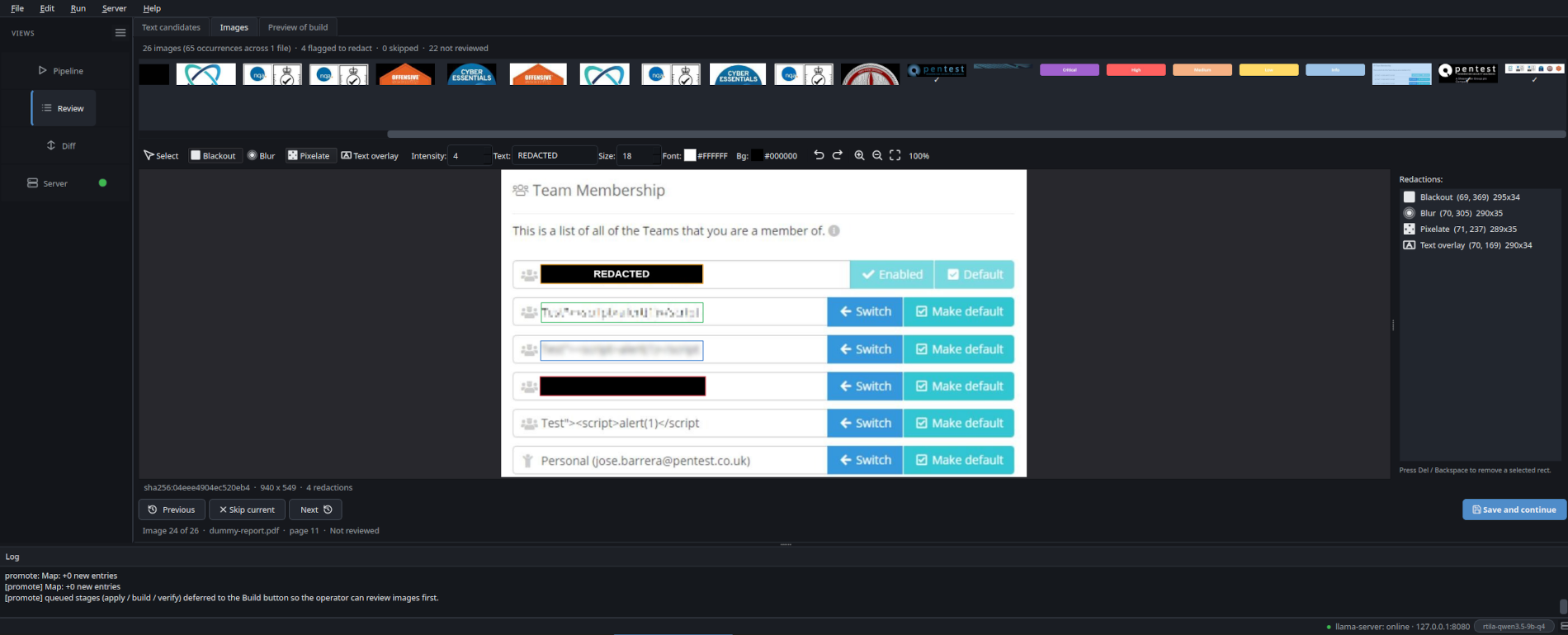
Four tools are available in the per-image editor, all rendered into actual baked pixels (the canvas re-renders on every change so the operator sees the real result, not a translucent overlay):
| Tool | Renders | Use case |
|---|---|---|
| Blackout | Solid black rectangle | Customer logo, sensitive name in a screenshot |
| Blur | Gaussian blur (configurable radius) | Faces, screenshots whose context matters but identifying details don't |
| Pixelate | NEAREST-resampled mosaic | Same as blur but with stronger irreversibility cues |
| Text overlay | Coloured background rectangle + centred text | "REDACTED" badges, custom labels with custom font / background colour |
Identity guarantee. Apply replaces image bytes IN PLACE at the
same xref (PDF) / shape position (DOCX, PPTX), so the output
keeps the same number of images, in the same files, in the same
positions, with the same dimensions. The verifier post-stage
asserts this via an inventory cross-check; any mismatch is logged
in verifier_report.md.
Out of scope (intentionally). OCR-assist (auto-detect text regions) is not implemented; vector-graphics inside PDF pages are flagged with a warning but not editable from the GUI; ODT and XLSX images surface a "no editor support yet" notice. None of these affect the text pipeline, only the image-redaction surface.
What the pipeline never touches
The following classes of strings are deliberately preserved because removing them would break the report's technical narrative or because they are not customer-identifying.
- Technical content of the report: descriptions, payloads, exploit code, shell commands, tool output snippets, request / response bodies (only the values they contain may be flagged, not the surrounding code).
- Standards and well-known libraries: NaCl, libsodium, OpenSSL, OAuth, OAuth2, JWT, SAML, OIDC, WebRTC, FCM, APNS, OneSignal, Firebase, Google Play Services, Apple Push, libsignal, Curve25519, Ed25519, AES, SHA-256, HMAC, PBKDF2, Argon2.
- Standard constants and reserved ranges: RFC 5737, RFC 1918, loopback, well-known public DNS, RFC 2606 example domains.
- Generic OS / SDK / library versions:
Android 10,iOS 17,Java 17,Python 3.12,OpenSSL 3.0. - Generic hardware models:
Samsung SM-A920F,Xiaomi Redmi,Pixel 7,iPhone 14, these are lab-test details, not customer-identifying. - Dates in any format:
7 May 2026,2026-05-07,7 maggio 2026. - Generic file names and project paths:
ADVISORY.md,README.md,exploit_usage.md,debug_server.py,data/dev_keypair.json,src/main/java/...,proof/screenshot.png, technical artefact names. - Generic descriptive endpoints:
/api/v1/login,/healthz,/metrics,keyserver/v1/publish. - Variable / function / class names found in code (including
R8 / ProGuard obfuscated names like
pi.a.n,zi/a.java,License.WebServiceURI,sodium_key,key_id,encoded_key,OWN_KEY,DEV_PUB,VICTIM_PUB,crypto_box). - Test / placeholder identifiers that already document an
attack:
VITTIMA,VICTIM,Lab1,Lab2,attaccante,mitm. - Generic security terms: MITM, CSRF, XSS, RCE, SSRF, CVE-*, CVSS, CWE, OWASP.
- Already-anonymized values: previous placeholders
(
+39NNN0000NNN,203.0.113.NN,vendor.example,X-Vendor-*,VENDOR-CHAIN-*).
How the two tiers cooperate
- Tier-0 (
anonymize/rules_pass.py) is a deterministic regex pass. It catches phone numbers, IP addresses and 32 / 64-hex tokens without touching the LLM, and assigns a stable index (+393331111111always resolves to the same placeholder viadecisions_history.jsonl). Tier-0 hits auto-promote. - Tier-1 (
anonymize/detector.py) is the LLM detector with the prompt described above. It walks the document chunk by chunk via the structure-aware splitter, emits candidates with category + suggested placeholder + confidence, then a critic pass checks each candidate against the "is this really a customer-identifying value?" question. High confidence + critic-approved candidates auto-promote; the rest go to the human Review queue.
Why the categories matter
The category drives:
- Placeholder format: phones get
+CC<carrier>0000NNN, IPs get RFC 5737, hex tokens get the 8-char-prefix-preserving rule, etc. Code inanonymize/placeholders.py. - Auto-promotion threshold: some categories (Tier-0 phones,
Tier-0 IPs) auto-promote on the first hit; others (
brand,credentials,other) require critic agreement. - Per-project review: in the GUI's Review pane, candidates are grouped by category so the operator can blast through homogeneous sets quickly (approve all phones, edit questionable brand variants by hand).